Chimney Cat
Games
Presents
TUNNEL STORY
HERO STORY
The Hero Loop. The Pressure Party.
Hostage-Based Progression: Tunnel Story uses a hostage economy instead of a death economy.
In Tunnel Story, there are no deaths. Monsters are your XP, your gold, and your health. They fuel your Hero upgrades, buy your loot, and decide whether you live to fight another day. Heroes are not the permanent part of your party. They wear down, fall, and eventually retire. You will go through many, each bringing new charm, skills, and risks to the table.The Hero system defines your party’s support layer. Heroes add combat boosts, healing, movement tools, utility, and tactical identity to your run.Heroes are not chosen during setup. They are drawn randomly. This means every run asks the same question: What can this party do well, and what do I need to protect? You must evaluate the Heroes you receive and adapt your playstyle around them.Heroes are not just empty shells. They are the layer between your Relic and failure. When you take damage, you choose which Hero receives the hit. This turns your party into a tactical defense mechanic, forcing you to decide whether to sacrifice a weaker Hero or risk losing a stronger one.The Hero fades. But the Relic remains.
Let's check out the 8 Visible Parts of a Hero Card.
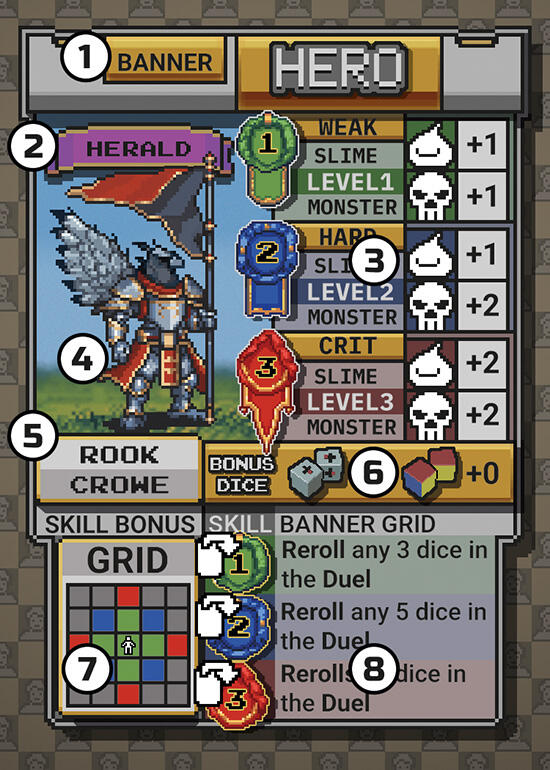
1. Hero Class (Top Left)
2. Behavior Trait (Middle Left)
3. Level Up Recipe (Middle Right)
4. Profile Picture (Middle Left)
5. Name & Race (Middle Left)
6. Bonus Dice Poll (Middle Right)
7. Skill Bonus (Bottom Left)
8. Skill Level (Bottom Right)
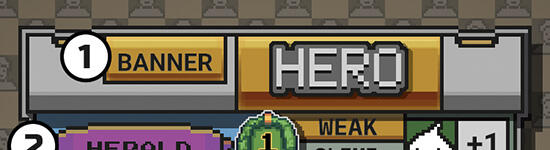
1. Hero Class (Top Left) One of the 6 Classes defines the Hero’s main party role.
◾Sword: Improves combat output and pushes fights toward a clean finish.
◾Shield: Reduces danger by blocking hits and protecting key moments.
◾Medic: Restores Heroes and helps the party recover from pressure.
◾Banner: Improves consistency through rerolls and broad support.
◾Tactics: Manipulates terrain, positioning, and information.
◾Support: Improves loot flow, hand economy, and unusual utility effects.
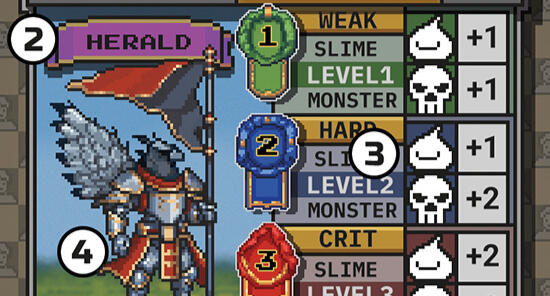
2. Behavior Trait (Middle Left) Behavior is flavor-facing and gives the Hero a classic fantasy identity, like warrior, ranger, mage, or healer. It helps frame what the Hero feels like during play.
3. Level Up Recipe (Middle Left) 3-step upgrade track showing what the Hero needs to reach Level 1, Level 2, and Level 3.
4. Profile Picture (Middle Left) The visual portrait of the Hero
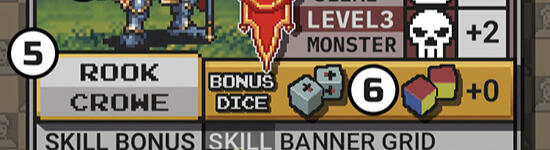
5. Card Name & Race (Middle Left) Gives each Hero a personal identity and one of six core races:◾Human: Versatile and balanced people with no extreme strengths or weaknesses.
◾Elf: Graceful and precise wanderers with a refined, mystical presence.
◾Dwarf: Tough, grounded survivors known for endurance and resilience.
◾Meowkin: Quick, clever feline folk with playful speed and instinct.
◾Crowe: Sharp, watchful birdfolk associated with cunning and awareness.
◾Twee: Small, unusual beings tied to wonder, curiosity, and odd magical charm.
6. Bonus Dice Pool (Middle Right) Shows the Hero’s passive starting contribution to your dice pool. These values are kept low to preserve clean math and fast turns. Add up all your Heroes' dice pools!
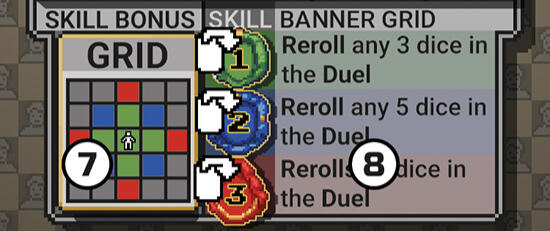
7. Skill Bonus (Bottom Left) Every Hero has a passive Skill Bonus that is always active while the Hero is in play. Like Relics, these bonuses use one of six types:
◾BANE (monster-focused)
◾WRIT (mystical/rule-bending)
◾HAND (loot/economy)
◾LUCK (rerolls/consistency)
◾WALK (movement/terrain)
◾GRID (co-op support)
8. Skill Level (Bottom Right) (Level 1, 2, and 3)
The Hero’s main active ability track. As the Hero levels up, this skill unlocks stronger, wider, or more efficient effects.The name of this Heroes Skill is Banner Grid.Skill Levels come in two types: TAP skills require the Hero to be tapped to activate, making them Exhausted after use. PAS (Passive) skills are active in Exhausted or Wounded, but not K.O. heroes. Knocked out heroes are unconscious and the party loses the Skill Levels abilities.
THE LEVEL UP RECIPE & HERO SKILLS
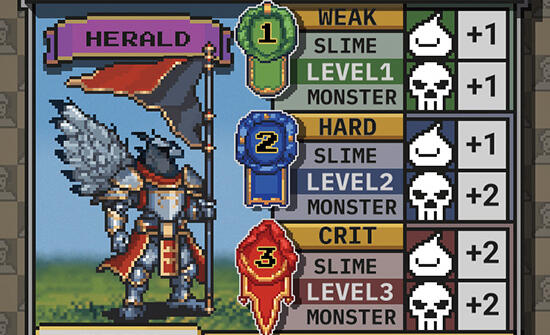
The Level Up Recipe Leveling up is not automatic. It is an economic choice. Each Hero card features a Level Recipe showing exactly what resources, like specific captured Monsters or Loot, are required to reach 🟢Level 1, 🔵Level 2, and 🔴Level 3.
You must choose to spend those hard-earned resources to unlock the next tier of power.
Hero Skills (The Active Payoff)
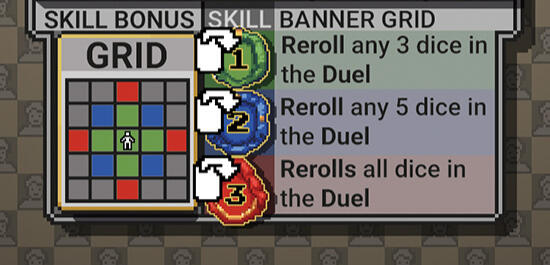
While Skill Bonuses are passive, Hero Skills are the active abilities your party relies on to survive the tunnels. As you complete the Level Recipe, the Hero Skill grows stronger:
🟢Level 1 is the baseline utility.
🔵Level 2 offers improved reach, damage, or efficiency.
🔴Level 3 is the ultimate payoff. A Hero that survives long enough to reach Level 3 becomes incredibly valuable and should feel worth protecting.Reinforcing the Relic: Remember, the Hero provides the recipe and the skill, but the Relic owns the level. If a Hero levels up and is later forced into retirement, the new Hero drafted into that slot inherits that stored level and immediately unlocks their own matching skill tier.
THE HERO GROUPS: Defining Your Tools
The Hero Deck contains 36 cards divided into four distinct groups.
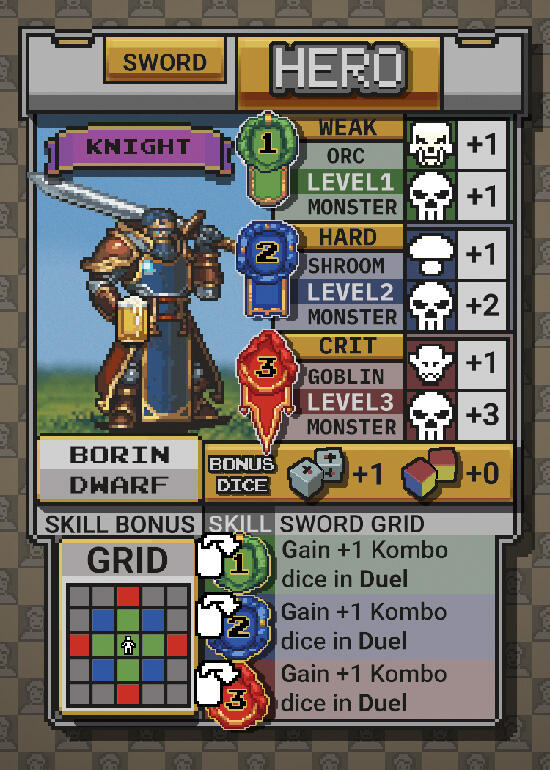
◾Grid Heroes (The Co-Op Foundation): Grid Heroes teach support range and party positioning. They do not scale with bigger numbers. They scale by who they can reach. The Grid image on the card shows their targeting pattern.
🟢Level 1 targets adjacent Terrain space (Green)
🔵Level 2 targets Terrain diagonals (Blue)
🔴Level 3 targets two Terrain spaces away (Red)
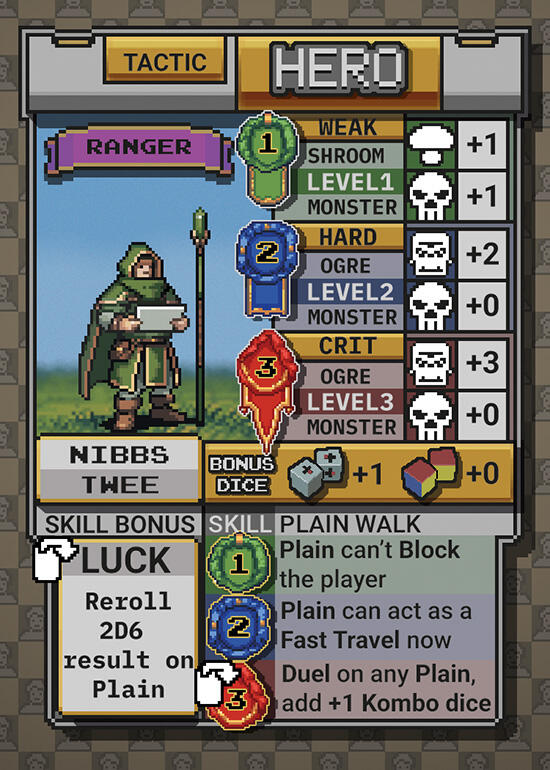
◾Walk Heroes (Terrain Specialists): Walk Heroes improve movement and reduce terrain friction. Each one is tied to a specific terrain type, Forest, Field, Plains, or Pond, and rewards smart route planning.
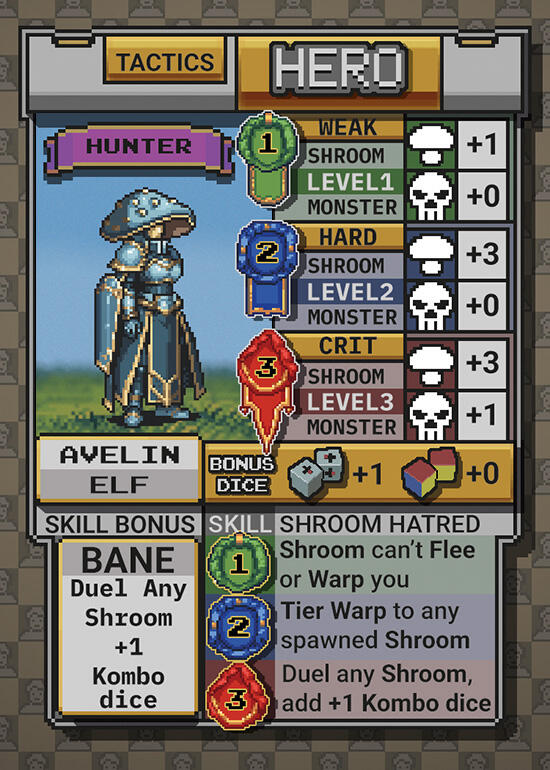
◾Hatred Heroes (Monster Specialists): Each Hatred Hero focuses on fighting one specific monster species, Goblin, Slime, Ogre, or Orc. They reward focused aggression against that exact target.
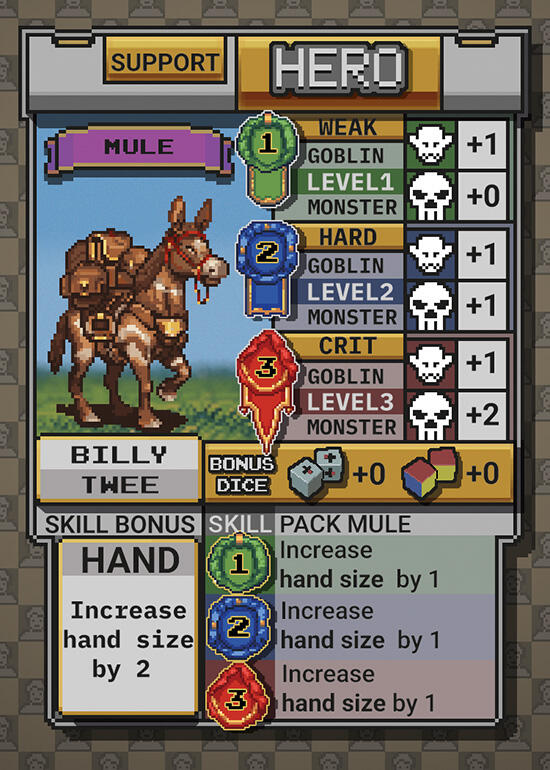
◾Special Heroes (The Wildcards): These are the unique, one-off Heroes in the deck. They provide stronger, stranger, or more situational effects, focusing on high-risk mobility, big combat swings, or resource gain.
THE HERO LIFECYCLE: Recover, Replace, Retire
Heroes are not permanent. They are recruited, used under pressure, damaged over time, and eventually healed, retired, or replaced.
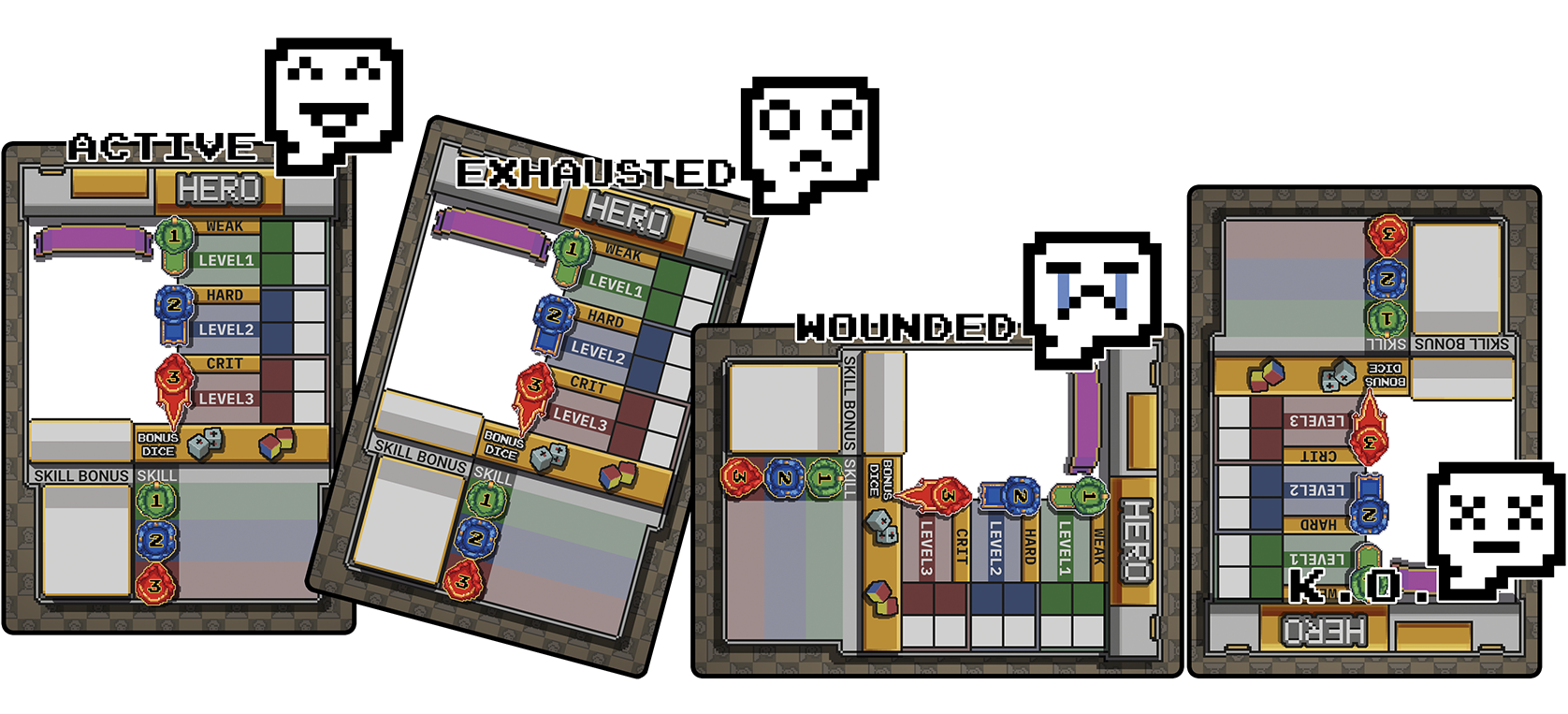
Hero States
◾Active: The Hero is upright and works normally.
◾Exhausted: Tapped to the right. Skill Levels cannot be used, but the Hero can still take damage.
◾Wounded: Turned 90 degrees. The Hero is active, but one more hit makes it K.O.
◾KO: Turned upside down. A K.O. Hero cannot use Skill Levels and cannot receive damage. Crucially, a K.O. Hero remains taking up space in your party until you find a way to resolve their fate.
IMPORTANT: Passive Skill Bonus remains active in all Hero states: Active, Exhausted, Wounded, and K.O., until the Hero retires permanently. A Tap Skill Bonus does not.
How to Recover or Replace Heroes
You are not stuck with a K.O. Hero forever, but fixing your party requires using your resources or navigating the map to safety.◾At Camp: A temporary safe space on the board, where you must decide the fate of your K.O. Heroes. Camp allows you to Heal or Retire 1 K.O. Hero only, while Active, Wounded or K.O. Heroes can only be retired at Town.(A camp can only retire 1 K.O. Hero, Town can retire 1 hero at any condition)Heal: Return the tapped, wounded, or K.O. Hero to Active upright status. Their level skills are fully restored.
Retire: Remove the K.O. Hero from your party permanently.
Recruit: If you retire a Hero, you may draw a new one from the deck to fill their empty slot.◾At Town: The primary safe hub. Unlike temporary Camps, Towns allow for full party recovery, clearing Junk from your hand, and complete roster management without the immediate pressure of the wild.◾Loot Cards: You do not have to wait for a Camp or Town to save your party. Mini Loot cards, like healing items or recruitment actions, allow you to heal heroes or a recruit a new hero right in the middle of exploration.◾Relic Burns: In a crisis, you can always rely on your Relic. As seen with Relics like the Hymn Blade, burning a Hero’s level can trigger massive, immediate recovery effects that help you heal or revive your party from anywhere on the map.
PLAYING HEROES WELL: Tactical Questions
Good hero play is not about finding the strongest single Hero. It is about reading the party you have and using it well. The best players do not force one perfect strategy every game. They learn the party they drew and turn it into an advantage.During a run, constantly ask yourself:◾Which Hero should take this hit?◾Which Hero is worth healing, and which is worth retiring?◾Which skill matters most right now in this specific run?◾Does this exact party support my current terrain movement, my active monsters, and my equipped Relic?Grid Heroes reward positioning. Walk Heroes reward movement planning. Hatred Heroes reward target priority. Special Heroes reward uniqueness.You don’t need a perfect party. What matters is how you use the one you have and turn it into an advantage.
That is the Hero system of Tunnel Story. These are the party members that keep your run alive, turning pressure into choices, damage into sacrifice, and random draws into tactical advantage. Learn the Heroes you have, protect the ones that matter, and make the most of the party you are given.
Coming very soon: LOOT!LOOT!LOOT!

Have a great summer!
Chimney Cat team
(Note: All cards/rules are subject to change before final release)
If you missed our campaign, don't dismay! Just click the cart.
© 2026 Chimney Cat Games Ltd. All rights reserved.